
The brief came with a constraint we do not usually accept: no link building. No outreach, no placements, no budget for either. The operator wanted to know what a new domain could earn on its own merits before anyone spent money on authority.
So we ran the programme without that pillar. This is what we did instead, in the order we did it, and what it produced.
The brief
An online casino brand reaching Malaysian players from an offshore licence, on a new domain with no organic history and a deployment date already fixed.
Online gambling is prohibited in Malaysia, and the demand is served by offshore-licensed operators for whom organic search carries most of the acquisition. We scope that work only with the legal position documented in writing first, and it is documented here for the same reason. Malaysia
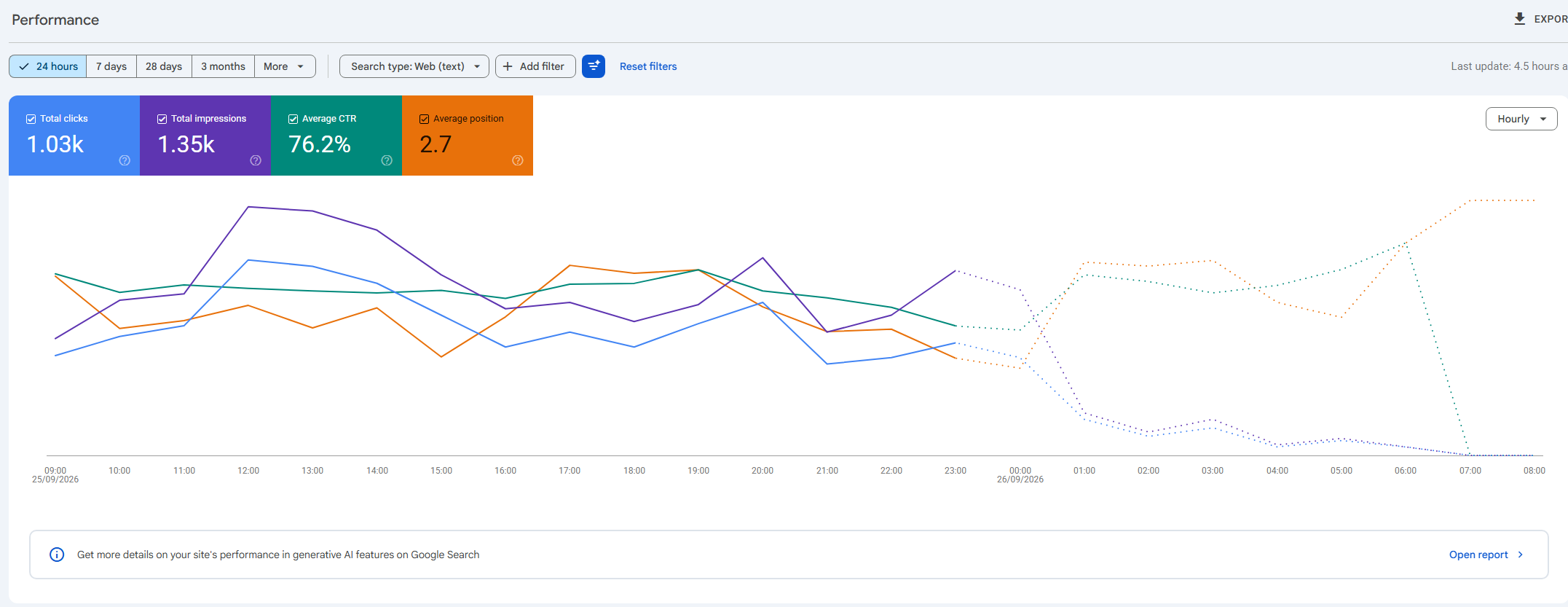
The question the operator wanted answered was narrow and fair: how far does a new site get on structure, indexation and query selection alone, before authority is bought? Almost nobody answers it honestly, because the answer is unflattering to the retainer. We agreed the window shown above, a single success metric, and a rule that nothing would be published without a Search Console export behind it.
Where it started
Zero. Not "low" — zero clicks, zero impressions, and a set of pages Google had not yet decided to keep.
The panel above reports the window, the channel and the figures exactly as Search Console shows them, as an unedited export rather than a redrawn chart.
What we found
The opening audit produced three problems, none of which were content problems.
Indexation was the binding constraint, not ranking
A meaningful share of the estate was crawled and then not indexed. On a new domain that is a quality and differentiation judgement rather than a technical fault, and no amount of resubmission moves it. The game and category pages had been generated from one template and looked interchangeable to Google because they were interchangeable.
The language split was being handled as a translation problem
Malaysian casino search runs across Bahasa Malaysia, English and Simplified Chinese, and the three behave differently — different brand spellings, different game names, different payment vocabulary. The site had one language's keyword set translated into the other two, which reliably produces pages that rank for nothing in any of them.
The architecture pushed equity at the wrong pages
Navigation and footer boilerplate accounted for almost every internal link. Utility and legal pages were the best-linked documents on the site; the lobby, game and payment pages that actually convert were reachable but barely reinforced, with the same two or three anchor strings repeated everywhere.
What we did
Indexation first, and nothing else until it moved
We rebuilt the sitemap, referenced it from robots.txt, verified coverage daily, and treated every "crawled – currently not indexed" page as a differentiation failure to fix rather than a queue to wait in. Each game and provider page was given material that existed nowhere else on the site — mechanics, volatility, provider, the deposit methods it supports. Pages stopped looking interchangeable and started getting kept.
We researched each language natively instead of translating
Keyword sets were built separately in Bahasa Malaysia, English and Simplified Chinese, in the local result pages, with brand and game names recorded in the spellings players actually type rather than the ones the brand uses. Payment content was matched to how deposits are really made in the market. Multilingual SEO
We picked the SERPs we could win, by reading them
Difficulty scores were a coarse filter and nothing more. Every candidate query was opened and the result page read: who ranks, how strong, how old, how well it answers. Where the top results were forums, aggregator pages and thin copies, we took the query. Where they were established brands with real authority behind them, we left it, whatever the tool said.
We took the brand SERP before anything else
Brand and brand-plus-modifier queries — login, app, bonus terms, withdrawal, support — were given owned pages with structured data, in all three languages. On a domain with no authority these are the only high-intent queries winnable immediately, and they are the ones an operator most cannot afford to leave to someone else.
We weighted the rest toward transactional intent
Informational queries are where click loss from AI answers is concentrated; navigational and transactional queries are measurably far less affected. SSRN-2026 That distinction set the content order: lobby, game-title, provider and payment pages carried the click target, and explanatory material was written because players ask for it, not because it was expected to earn traffic.
We rebuilt the internal architecture
Every commercial page was linked from its category hub, from the relevant payment or provider page, and from any article that named the game, with hand-written anchors instead of the navigation label repeated. Boilerplate links to pages that did not need reinforcing were trimmed. Click depth came down to three. This was the highest-leverage work in the engagement and it cost nothing but attention.
We rewrote the listings, not the pages
Titles were cut to the band Google actually keeps, the brand suffix dropped from interior pages, pipes replaced with a single dash, and every H1 aligned to its title so Google could tell which was the real heading. We did not force our own meta descriptions; Google's snippet selection, informed by query data we do not have, consistently outperforms the copywriter.
From month two we stopped publishing and started mining
Once impressions accumulated, the work became pulling every query with impressions and near-zero clicks, mapping each to the page Google had chosen to show, and rewriting only those. Iterating against demand we had already proven existed beat guessing at new demand, every month of the engagement.
We reported every 30 days
Clicks, impressions, average position and index coverage by language, reconciled against the operator's own analytics, with the queries that moved and the ones that did not.
What happened
The figures are on the panel above, taken from Search Console for the window shown, with the baseline and the channel stated. There is no second chart and no comparison against a period chosen after the fact.
The shape is the part worth reading. Nothing happened for the first month after deployment. Pages were being crawled and assessed, not ranked, and the dashboard stayed flat enough to be alarming. Impressions arrived before clicks, and they arrived spread thinly across many pages rather than concentrated on one.
No single page ever became a traffic hero. The total is the sum of a few dozen pages each earning a modest number — brand queries first, then game titles and payment terms — which is the only realistic shape for a domain with no authority behind it. Anyone planning this work should budget for that silent first month, because it is exactly where these programmes get cancelled.
What the operator measured
Registrations and first-time deposits from organic landing pages, tracked against the cost of paid acquisition in the same market. Those figures are commercially sensitive and stay under NDA. The Search Console record above is published because it can be checked the way you would check it yourself.
The commercial conclusion the operator drew was the one they set out to test: authority was worth buying, but not yet, and not before the structure could hold it.
What we will not claim
That no links arrived
We ran no outreach, bought no placements and published no guest posts. Referring domains that appeared on their own are counted and disclosed in the operator's reporting. Any case study claiming literal zero without publishing a referring-domain count has not measured it.
That this takes the most competitive casino terms
It does not, and it was never scoped to. The generic high-volume category queries in this market are held by aggregators and established brands with years of link acquisition behind them. The best-documented zero-to-scale programme in the vertical still spent roughly a third of its effort on link building and took about eighteen months. SEOPROFY-2026 What on-page work takes is the brand SERP, the long tail of game and payment queries, and the language segments competitors translate rather than research. iGaming Link Building
That it scales indefinitely
It plateaus, and predictably: the moment the target moves from brand and long-tail terms to the head of the category, link equity becomes the binding constraint and internal linking stops substituting for it. This method reaches the first few thousand clicks and builds something worth linking to. It does not replace authority.
That the timeline transfers unchanged
Click yield has fallen across the whole market. Any schedule borrowed from a case study written before 2024 should be lengthened, not copied.
What transfers
The order, above all. Indexation before architecture, architecture before content, content before listings, and listings before anything is published a second time. Running those out of sequence is the most common reason this work fails.
The language discipline transfers to every multilingual market we work in: research each language in its own result pages, never translate a keyword set, and report index coverage per language rather than per site. South East Asia
And the reporting standard. Every number in this case has a baseline, a period, a channel and a source. That is not a stylistic preference — it is what made the conclusion trustworthy enough for the operator to act on. Case studies
Frequently asked questions
No, and we said so before the engagement started. Those results are held by aggregators and established brands with years of links behind them. On-page work takes the brand SERP, the long tail of game and payment queries, and the language segments competitors translate instead of researching.
We ran no outreach, bought no placements and published no guest posts. Links that arrived on their own are counted and disclosed in reporting rather than hidden.
About a month from deployment. Indexation on a new domain is measured in weeks rather than days, and that quiet first month is normal rather than a sign the work has failed — it is also where most programmes like this get cancelled.
Because Malaysian casino search genuinely runs in three, and they do not share a keyword set. Brand spellings, game names and payment vocabulary differ enough that a translated page ranks in none of them. Researching each language natively was one of the two largest sources of gain in this engagement.
Because the operator asked what the site was worth without them. For most brands the answer is that both are needed — but establishing the on-page ceiling first tells you precisely what the link budget has to buy. iGaming Link Building
The export behind the panel above is shown with its date range visible. Operator-side figures — registrations, deposits, cost per acquisition — stay under NDA and are not published here in any form.